


Decide what the accent should do.
Leather can introduce a tactile detail to selected cabinet fronts, panels or other surfaces. Start with the place you want it to appear and the role it plays in the room. A small drawer-front accent and a large backing panel create different visual effects and different practical requirements.
Consider how frequently the area will be touched, how it will be cleaned and how it meets adjacent materials. Those questions help keep the choice connected to the room’s use.
Distinguish the product families.
EcoDomo offers different leather products for different applications. The supplied options include recycled leather veneer and selected wrapped-front directions, while other families serve separate uses. Recycled leather veneer contains leather; it should not be described as vegan.
Keep the exact product name attached to the sample you are considering. Similar-looking textures or colors do not make different product families interchangeable.
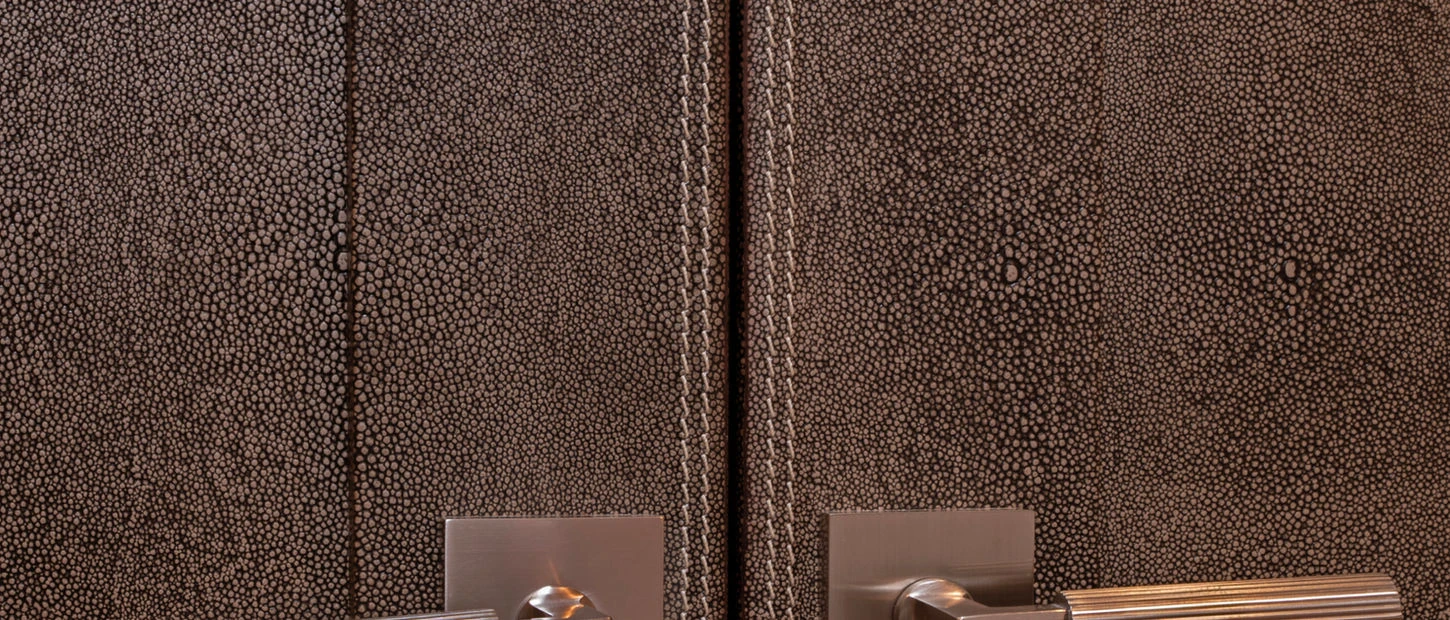
Treat texture names as descriptions.
Names such as Shagreen or Crocodile describe surface patterns in the supplied selection. They should not be read as a claim that the surface uses that exotic animal species. Ask what the actual material is and how it is intended to be applied.
This is also a reason to see a physical sample. A photograph can suggest a pattern, but it cannot communicate the tactile quality or how the surface relates to neighboring cabinetry.
Confirm the front or panel construction.
Wrapped profiles, flat panels and adhesive-backed products have different specification questions. The supplied wrapped-front profile names are Infinity, Penta, Shaker, Slim Shaker and Shaker Frame. Their presence in a selection guide does not mean every texture and color is available with every profile.
Discuss the substrate, edge treatment, front dimensions and the intended application with the selected product. Avoid approving a color alone and leaving those decisions unresolved.

Use the accent with a restrained palette.
A tactile surface often works best when the surrounding materials give it room to be noticed. Compare it with the cabinet finish, hardware and nearby textiles. Decide whether the goal is a quiet tonal layer or a more visible contrast.
Save the chosen product family and sample name with the project records. Before ordering, confirm the current combination and care guidance for the exact application rather than relying on a general impression from the website.
Choose a Specific Application Before Choosing a Texture
Consider three ways to use a leather accent: a small drawer group, a door-front composition or a backing panel behind display shelves. The first concentrates the tactile detail where it will be handled; the second makes it part of the cabinet elevation; the third creates a quieter background. Compare the proposed area with the room as a whole.
For the shortlist, write down the EcoDomo product family, sample name, texture, substrate and edge treatment. Ask for care instructions for that exact product and use. A photograph of a countertop or door demonstrates a design possibility; it does not establish that every leather selection can be used on every surface.
The installed examples and texture images in this guide help you evaluate scale and appearance. Use a physical sample to judge the feel and the relationship to hardware and adjacent finishes.
Compare the Choices
| Choice or situation | What to consider | What to check |
|---|---|---|
| Drawer-front accent | A focused area of texture. | Coordinate pull placement and edges. |
| Wrapped door | A larger repeated surface. | Confirm profile, dimensions and available material combination. |
| Display backing | Texture behind selected objects. | Review shelf spacing, lighting and visible joins. |
Put This into Practice
- Identify where the leather will be touched or cleaned.
- Keep the exact sample and product names together.
- Confirm current care and fabrication guidance before approving the detail.
Product References
Consult the manufacturer’s information and confirm the exact specification for your project.