

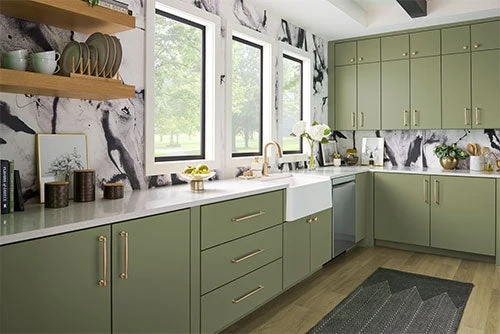
Look at the repeated pattern.
One sample door can be attractive on its own while feeling busy across a long wall. Consider how many fronts repeat in the design and how the lines align. A restrained profile may give a complex layout calm, while a more pronounced frame may suit a simpler arrangement.
Neither direction is universally better. The question is how the repetition relates to the room and the feeling you want.
Compare tall doors and shallow drawers.
The same profile can read differently at different sizes. Review how it appears on a tall cabinet door, a wider front and a shallow drawer. Edge and rail proportions may become more noticeable when the front is small.
A sample wall is a helpful starting point, but the actual elevations show how the choices will work together. Ask to consider the profile in the proposed cabinet arrangement.
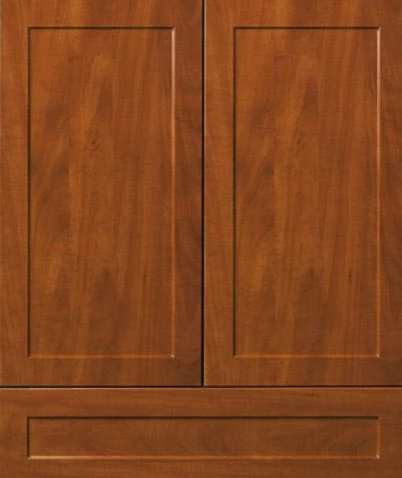
Connect the finish and the shape.
A solid color emphasizes shadow and proportion differently from a wood-inspired grain. A textured material can add another visual layer. Compare these elements as a combination rather than approving the color and profile in isolation.
Also consider nearby architectural details. Existing door casings, baseboards and other cabinetry can help establish the room’s visual language without requiring an exact match.
Give hardware a place in the decision.
A knob or pull changes the appearance and operation of the front. Think about where it sits relative to the profile and whether it is comfortable to use on that door or drawer. Projection and nearby clearances can matter in compact spaces.
If existing hardware or holes must be retained, mention that early. The practical constraints may narrow the choices before the final finish is selected.
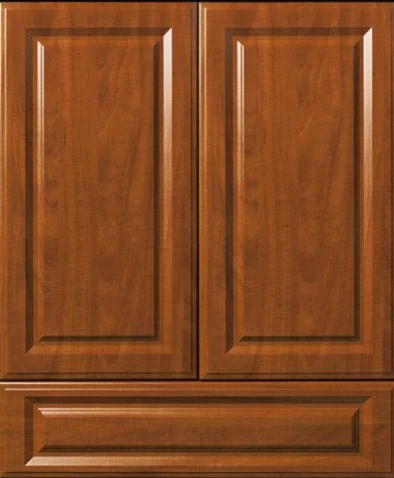
Confirm availability for the chosen system.
Door-style photographs do not establish that every profile is available in every material, size or cabinet line. Confirm the exact combination with the selected system. This is especially important when comparing a general finish palette with a named manufacturer’s cabinetry.
Record the approved profile alongside the finish and hardware. A clear selection record helps prevent a similar-looking alternative from being mistaken for the final choice.
Compare the Same Finish on Different Front Shapes
Start with one finish so color does not distract from the profile. Compare a flat front, a simple framed front and a more pronounced profile at the scale of your proposed cabinetry. Then repeat the comparison on the smallest drawer as well as a tall door.
If a room contains many narrow drawers, every frame adds another line. A simpler front can quiet the elevation. If a large door wall feels too plain, a profile can add shadow and rhythm. Review handle placement at the same time; the shape and hardware need to look intentional and remain comfortable to use.
Compare the Choices
| Choice or situation | What to consider | What to check |
|---|---|---|
| Flat or slab direction | A continuous, restrained surface. | Grain and hardware become prominent details. |
| Simple framed direction | A clear border and repeating shadow. | Check proportions on small drawers. |
| More detailed profile | A stronger architectural pattern. | Consider the cumulative effect across the whole room. |
Put This into Practice
- Compare a full cabinet elevation, not only one sample.
- Check handle placement and nearby clearances.
- Confirm the profile is available in the chosen cabinet system.